Void Principle
Stop Seeking Productivity
Measure worth on skill, care, consequence—not extraction metrics. Real work happens in the margins between action.
The Planner’s Almanac — Philosophy + Tools + Celestial Timing
Sanity cannot be earned inside broken frameworks. Build on your own measures—rhythm, transparency, and work that matters.
Void Principle
Measure worth on skill, care, consequence—not extraction metrics. Real work happens in the margins between action.
Void Principle
Plans break. Markets shift. The only certainty is flux. Embrace the unknown—that’s where innovation lives.
Void Principle
Micromanaging your schedule doesn’t protect you—it exhausts you. Let go. Guide from the edges, not the center.
Void Principle
The external voice will never be loud enough to fill the void inside. Build for your people, not the algorithm.
Void Principle
Finished beats perfect. Your voice matters more than pristine execution. Let the cracks show—that’s where light enters.
Void Principle
The void isn’t loneliness—it’s the shared space where all creation begins. You’re not building in isolation; you’re building into community.
An economy that rewards speed over depth, obedience over clarity, and conformity over empathy is not malfunctioning; that is its blueprint. The institutions that govern work, education, healthcare, and governance don’t fail—they succeed brilliantly at what they were designed to do: extract predictable value and consolidate power.
When you feel their friction, when you struggle against their rhythms, when you cannot conform your nature to their metrics, you are not broken. You are experiencing the designed output of systems optimized for a very different kind of human than the one you are.
Neurodivergent minds, creative problem-solvers, conscientious caregivers—these are the people who feel institutional friction first. A neurodivergent person might be told their hyperfocus is “distraction” and their systematic thinking is “inflexibility.” A caregiver’s distributed attention might be labeled “inability to prioritize.” A builder’s refusal to follow established processes might be seen as “insubordination.”
These diagnoses are not failures of the person. They are signals that the institution’s metrics do not include what the person actually produces—thought, care, consequence. Institutions operate as self-reinforcing systems. A corporation has incentives to maximize extraction; those incentives compound into structures and hiring. Those structures reward those who align with extraction and punish those who question it. Over time, the institution embeds its logic into culture, reward, language, and identity.
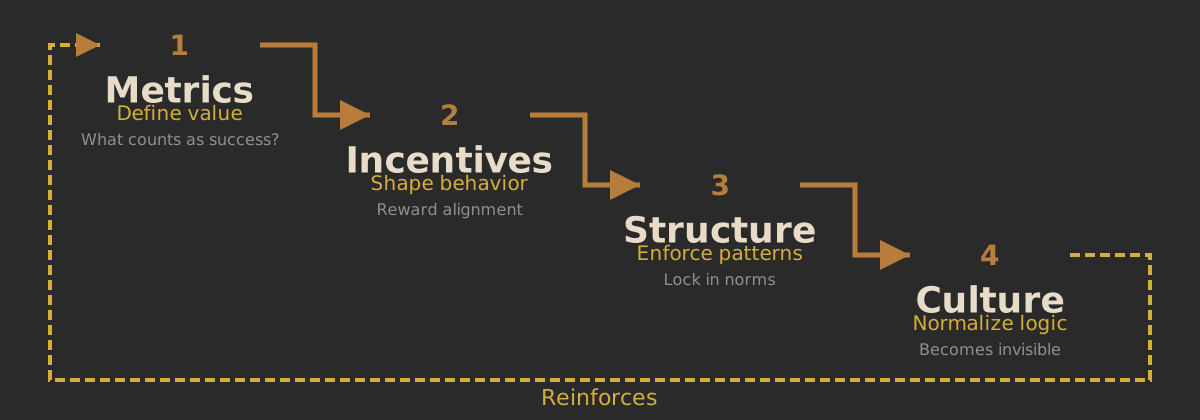
To question the institution is to question oneself—the logic becomes invisible, naturalized, assumed to be “how things work.” This is not accidental. It is architectural. The system doesn’t break down when it harms you—it functions exactly as intended. The harm is not a bug; it’s a feature designed to discourage resistance and ensure compliance.
The people who “succeed” in these systems often pay invisible costs. They may advance by metrics the institution recognizes—titles, salaries, promotions—while sacrificing depth, creativity, and integrity. They learn to perform alignment even when they feel misaligned.
They internalize the institution’s logic until they can no longer distinguish their own values from the system’s imperatives. This is what “fit” means in institutional terms: the capacity to suppress dissonance and align your behavior with extraction, even when it conflicts with your nature or your ethics.
“Institutions don’t fail to serve you; they succeed at serving their own perpetuation. The system isn’t broken—it’s working exactly as designed.”
Recognizing a system as designed—rather than inherently failing—opens possibility. If something is designed, it can be re-designed. If something is working as intended, you can withdraw your participation. You can build alternatives.
You can refuse to be the raw material for an institution’s perpetuation. Your pain is diagnostic data. Your friction is clarity. The alarm system is ringing because you are awake.
This doesn’t mean all institutions are equally harmful or that every corporate structure is inherently extractive. It means that when you feel friction, when you experience harm, when you cannot make the system work no matter how hard you try—consider that the problem might not be you. It might be the metrics. And metrics can be changed, rejected, or replaced.
The problem was never you. It was the metrics.
For decades, the conversation around institutional mismatch has been framed as individual failure. Neurodivergent people are told to “try harder to focus.” Caregivers are told to “set better boundaries.” Builders are told to “play the game before you change the rules.” Beneath all this advice lurks a toxic assumption: that if you are struggling, the solution is self-optimization. Fix yourself, and the fit will improve.
This framework is not just ineffective; it’s a deliberate misdirection. It places the burden of adaptation on the person, not the system. A neurodivergent person’s hyperfocus is not a flaw—it is a feature, an advantage in deep work. A caregiver’s distributed attention is not a failure—it is evidence of sophisticated context-switching. A builder’s resistance to hollow process is not insubordination—it is integrity. Yet institutions reward the opposite: they penalize depth for speed, punish care for efficiency, and crush integrity for compliance.
“We’re taught to optimize ourselves into exhaustion. No amount of personal productivity fixes a system designed to extract value.”
The self-optimization trap runs deep. You buy productivity apps. You attend workshops on “executive function.” You seek therapy to fix what a therapist identifies as systemic pathology—only to be offered tools for individual compliance. The metrics stay the same, the extraction continues, and exhaustion compounds.
When you accept self-blame, the institution wins twice: it keeps its metrics untouched and gets your unpaid labor of self-correction. You internalize failure that was never yours, spending attention and money to align to someone else’s extraction logic.
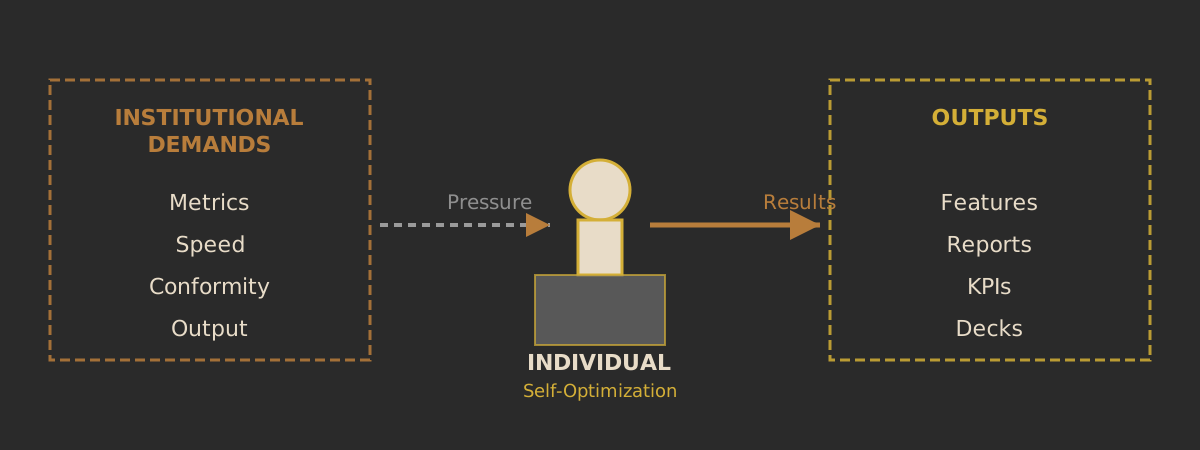
Here is the truth: you are not broken. The system is extractive, and you are awake to it. Your discomfort is evidence of your clarity. Stop seeking permission to optimize yourself into compliance. Leave early. Build elsewhere. Find people who measure you by different standards—and start by measuring yourself differently. Your integrity, your care, your depth—these are not obstacles to productivity. They are the work.
That unsettling feeling—the sensation that the world’s clocks and measures are off—is not pathology; it’s perception. When your inner instruments register mismatch between what institutions ask of you and what reality demands, that dissonance is diagnostic. You are detecting a system-level error from the inside.
Instead of correcting yourself to fit the noise, treat the signal as guidance. Dissonance clarifies values, reveals false metrics, and points toward alternative designs. Let the feeling name what’s wrong, then use that clarity to build work that reduces the gap between how things are and how they ought to be.
Mainstream economics flattens the world into a single dimension: exchange value. More money, more good. Higher GDP, healthier society. Larger profit margin, successful company. This one-dimensional lens has shaped policy, investment, and organizational culture for centuries. And it is catastrophically incomplete. Real economics operates on three simultaneous axes, and most systems optimize ruthlessly for only one.
What gets produced, by what process, and at what quality? Extraction maximizes quantity at minimum cost; craft maximizes integrity at honest expense. Most industries have abandoned this axis in favor of speed and volume.
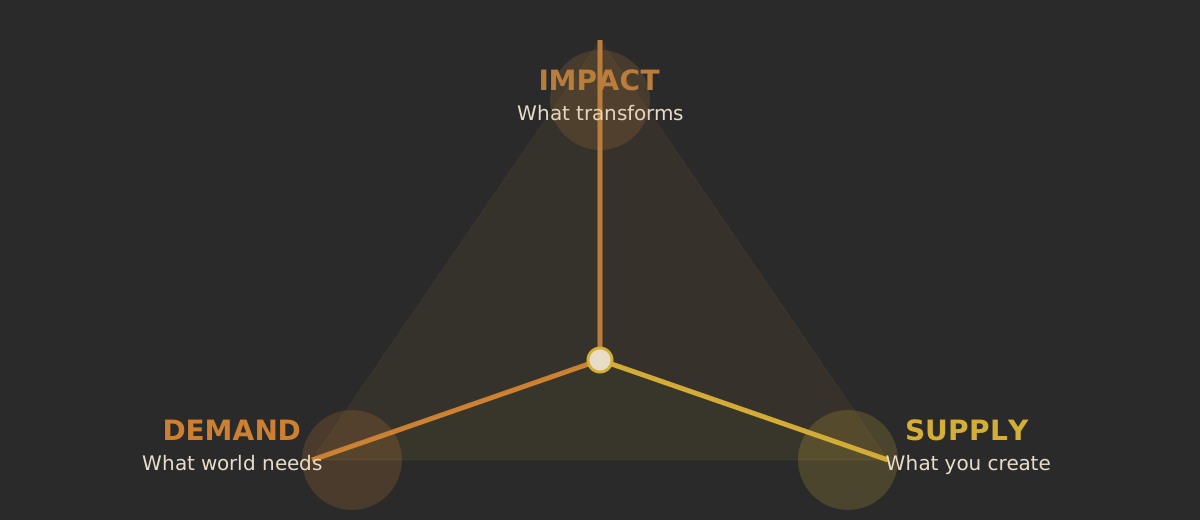
Markets manufacture desire through scarcity, status, and fear. Real demand arises from genuine human need. Systems that optimize for manufactured want deplete attention and trust. Systems built on real need compound loyalty and reputation.
What is the consequence? Does the work repair the commons, or consume it? Most institutions maximize extraction while externalizing costs: environmental damage, cultural erosion, attention depletion. A regenerative system bears its true costs in its accounting.
Once impact is included in economic calculation, extraction stops looking efficient. Regenerative systems that balance all three axes may appear less profitable in narrow accounting but produce stronger, more sustainable returns when externalities are measured truthfully.
If the institutions that govern work are misaligned with human flourishing, the alternative is not withdrawal. It is reorientation toward what actually matters. Joanna Macy calls this “the great work of our time”—the work of shifting from growth economics to life economics, from extraction to regeneration, from compliance to integrity. But this is not just large-scale transformation. It happens at the level of individual labor, choice, and identity.
Clarity about what you are trying to create or repair is the inner work. Not ambition, which seeks recognition, but authentic purpose, which seeks consequence. What problem do you see? What capacity do you want to build? What kind of human do you want to become?
“Intention without strategy is a wish. Strategy without intention is machinery. Great work holds both: a clear inner vision and a deliberate path to bring it into the world.”
Strategy bridges vision and reality: arranging conditions, relationships, and resources to bring intention into the world. Without strategy, intention is fantasy. Without intention, strategy is machinery.
Great work rarely finds immediate cultural reward. Institutions optimized for speed and extraction will resist depth and repair. Persistence carries you through doubt, resistance, and loneliness.
Great work becomes possible when you stop seeking permission from institutions that were never designed to support it. Build with others who hold the same clarity. Measure success by impact and integrity, work in rhythm instead of grind, and discover autonomy as the true reward.
Attention is your most precious resource. It is non-renewable within any given moment. What you attend to expands. Where you place your focus determines what you perceive, what possibilities you imagine, what kind of person you become. And attention has been industrialized, monetized, and systematically extracted from you.
The attention economy runs on your distraction. Notifications target you at the exact neurological moment when you are vulnerable. Algorithms maximize engagement—which means maximizing the time you spend not thinking for yourself. Platforms profit from your divided attention, and you blame yourself for inability to focus.
Distraction fractures your sense of self. When your attention is scattered across platforms, you lose the capacity for sustained thought, creative synthesis, and genuine connection. You become reactive rather than deliberate, a consumer of content rather than a creator of meaning.
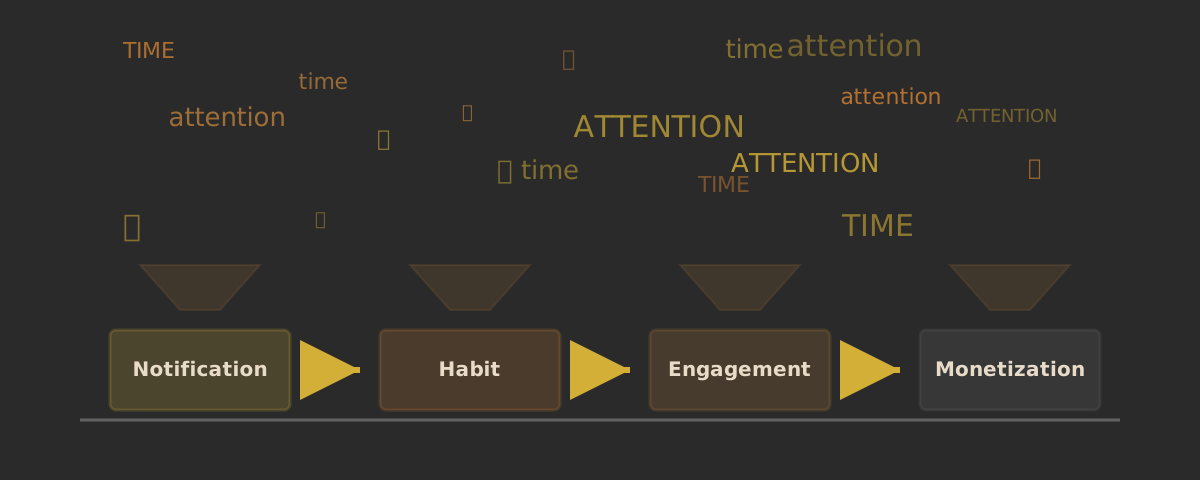
Reclaiming attention is radical autonomy: unplugging from systems designed to fragment you, protecting deep focus as sacred time, saying no to notifications, and building practices that sustain attention—meditation, reading, making things with your hands, spending time with people who respect your presence.
The system wants your attention fractured and reactive. Choose otherwise. Reclaiming focus is not a productivity hack; it is a political act that sets your own terms for what matters. Link your attention to your values, not to institutional metrics.
Transparency has become a corporate buzzword, stripped of meaning. “We are committed to transparency.” But transparency without understanding is theater. Showing you a 200-page terms of service you cannot read is not transparency; it is obfuscation dressed as honesty. True transparency would make systems illegible to those who profit from their obscurity.
“‘Transparency’ has become a smokescreen. Showing you a terms-of-service no one reads isn’t transparency; it’s theater. True transparency would make systems illegible to those profiting from their opacity.”
Algorithmic systems are the perfect example. We are told algorithms are transparent because policies are public, but no human can understand how a neural network makes decisions. Opacity is a feature, not a bug.
Real transparency shows the work: reasoning, cost, consequence. You can ask a system “why did you do that?” and receive an intelligible answer. Costs are visible—environmental, social, attentional—not externalized.
In the void, transparency is a governance structure: visible reasoning, clear economics, explained decisions, named trade-offs. It invites criticism and therefore invites trust.
Industrial time is flat. The 9-to-5 workday. The 40-hour week. The 52-week year. The quarterly earnings cycle. The annual review. This rhythmic structure was designed to extract maximum predictable labor from human bodies. It assumes that productivity is constant—that you can operate at the same speed, intensity, and focus every day, every season, every year. And it assumes this is normal. It is not. It is the opposite of human reality.
Institutional time is flat and extractive, built to maximize predictable labor. It assumes constant productivity and treats deviation from sameness as failure.
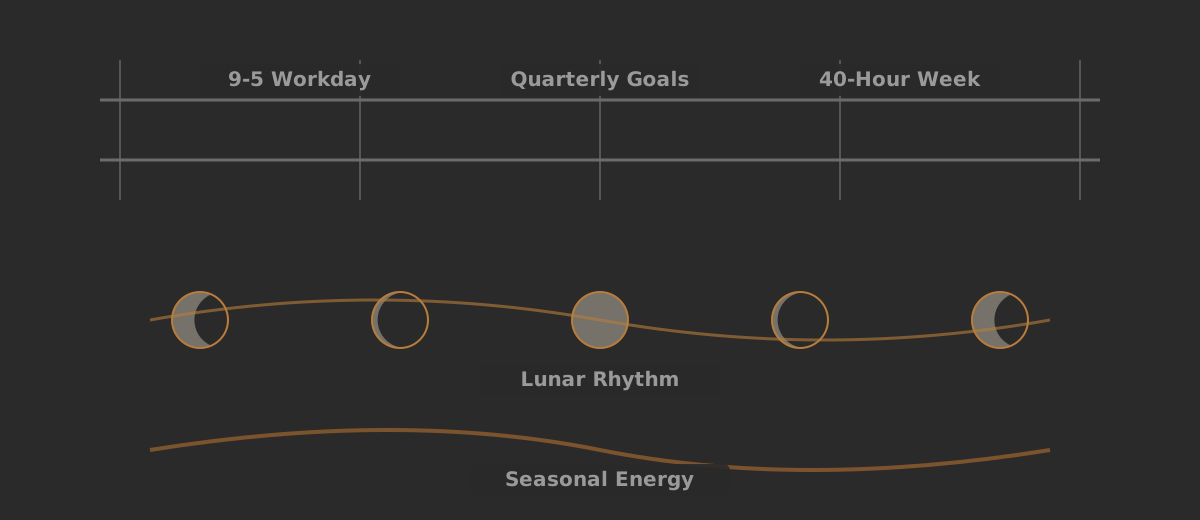
Human rhythms are interlocking: circadian peaks, lunar shifts, seasonal energy, personal cadence. These are biological facts, not quirks.
Protect peak focus for deep work. Work in sprint-and-rest cycles. Adjust commitments to seasonal patterns. Arrange life to fit your actual rhythm; measure output across whole seasons, not days.
Institutional time accelerates when stakes rise—more urgency, more meetings, more grind. Human time does the opposite: it slows for meaning. When work matters, you need more space to think, to feel, to decide. The inverse clock is the practice of expanding time precisely where consequence is highest.
In practical terms: widen decision windows for high-impact choices; compress routine tasks into bounded blocks; align deep work to lunar peaks and seasonal energy; reserve recovery when illumination wanes. Let clocks follow purpose, not the other way around.
Measured this way, velocity becomes honest. Some weeks sprint; some months gestate. Over a year, the rhythm resolves into real progress—not the appearance of speed, but the integrity of outcomes.
Here is where the institution shows its hand. Every system that demands uniformity punishes difference. Different learning styles? Wrong. Different circadian rhythms? Lazy. Different ways of thinking, processing, focusing, creating? Suspect. Neurodivergence isn’t a medical condition in the institution’s view—it’s insubordination. Non-binary identity? Disruptive. Deep introversion? Unhirable. Odd passions? Unrealistic. The institution’s baseline is always implicit: be normal. Be like us. Or be expendable.
Uniformity punishes difference. Neurodivergence is framed as insubordination, non-binary identity as disruption, and unconventional focus as laziness. The institution’s baseline is always: be normal or be expendable.
The most innovative work comes from the margins. Outsiders think differently because they must. That difference is not a bug—it is the source of innovation the institution discards.
Anti-Disclaimer
Comfort with the void includes comfort with your own difference. In the quiet, you see the patterns only you notice, the connections others miss, the way you move that is yours alone. Name it and honor it.
Stop apologizing for your difference. Your edge is what you offer; your otherness is not weakness. Use it intentionally—the void gives you space, but you decide how to build with it.
Normality is backward-compatibility. It is the reproduction of what worked for the last generation, encoded in policy, fashion, career paths, and social expectation. Oddity, by contrast, is evolution happening in real time. The strange idea. The unorthodox approach. The person who doesn’t fit the mold because they are building a different mold altogether. Treat strangeness as infrastructure, not ornament.
Normality reproduces the past. Oddity evolves the present in real time—strange ideas, unorthodox approaches, people building different molds entirely.
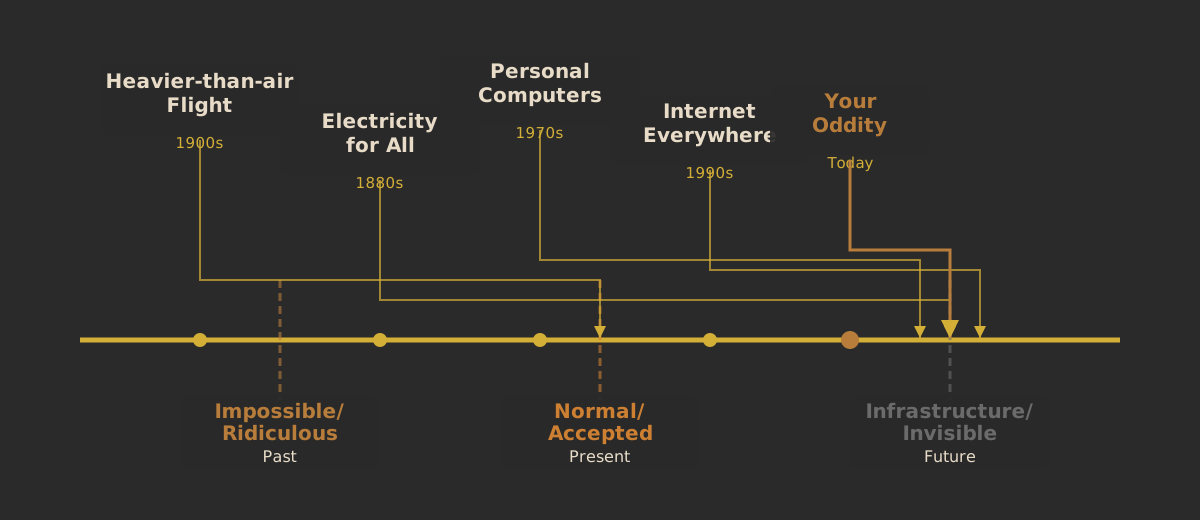
Electricity, aviation, the internet—each was ridiculed before becoming background infrastructure. Social shifts once deemed impossible are now obvious. They moved forward because “odd” people built outside institutional frames.
Seeing the world differently is not failure at the institution’s game—it is playing a different, often more important game. Oddity is direction; new solutions are born there.
Oddity that lasts requires discipline, clarity, persistence, and community. Grounded, intentional, collaborative strangeness is a powerful force for change. Your strangeness is infrastructure for the future you are building—honor it.
Axis
Measure worth on three axes: supply × demand × impact. Add the third dimension to escape false scarcity.
Meaning
Serve what’s real. Create what’s true. Love what’s worth the work. Replace validation with autonomous meaning.
Tempo
Build in cycles, not lines. Human time is rhythmic—seasons, moons, circadian flow. Restore it.
Governance
Make your process visible. Transparency is accountability—let people see how you work so they can trust what you build.
Currency
Guard where your focus goes. Attention is the currency institutions steal. Reclaim and spend it only on what matters.
Signal
Strangeness isn’t ornament—it’s evolution. What’s odd today becomes infrastructure tomorrow. Build strange things on purpose.
Stop blaming yourself for broken systems, measure on truer axes, and build work that stays honest, slow, and magnificently strange.